
Where it comes from
Everysaid is built from the phones’ own backups, from the services’ APIs and exports, and from the logs of the messengers people used twenty years ago. Each one is a source in the app: add it, set it up, import, and for the live services turn on the live connection.
| Source | How it is read | Live |
|---|---|---|
| iPhone | its encrypted backup, made over the cable: SMS, iMessage, calls, FaceTime, Viber, WhatsApp, with their media | no |
| Android | the call log, SMS, MMS and blocked numbers, read over adb | no |
| Telegram | its API, logged in from the app | yes |
| linked as a device, like WhatsApp Web | yes | |
| Signal | linked as a device, with the history the phone transfers when it links | yes |
| Viber | through Viber Desktop (Linux), with a bridge inside it | yes |
| Messenger, Instagram | Meta’s export (“Download your information”) | in progress |
| Adium, Pidgin | their logs: MSN, ICQ, AIM, Yahoo, Jabber and Google Talk, Skype, IRC, Facebook chat | no |
| Carriers | the missed-call notices they send by SMS, turned into calls | no |
Why the iPhone backup stays encrypted. iOS puts the call history in a backup only when the backup is encrypted. Everysaid makes and reads the encrypted backup itself, and nothing goes through iCloud.
What it keeps
Every message and call is kept once, whatever its source. The same SMS on two phones, the same WhatsApp message in the iPhone backup and in the live connection, the same call in two logs: paired and kept once, with every origin recorded.
- Messages as the services had them: replies, reactions, edits, deletions, forwards, mentions, locations, link previews, polls, and who received and read them, where the service tells.
- Calls with their outcome: missed, rejected, busy, blocked, video, group calls and who took part.
- People, not addresses: one person across all their numbers, emails and accounts, so their SMS, calls, Viber and WhatsApp meet in one chat. Names come from your address book (CardDAV or a .vcf file) and from what the services showed.
- Only ever added to: nothing leaves the archive because a phone or a service dropped it. Deletion happens only on your word.
- No channels. Channels, status updates and bots are not your conversations, and are not imported.
The app
everysaid serve is the whole app in one process: a messenger for the whole history, in the
browser on the desktop and installed on the phone.
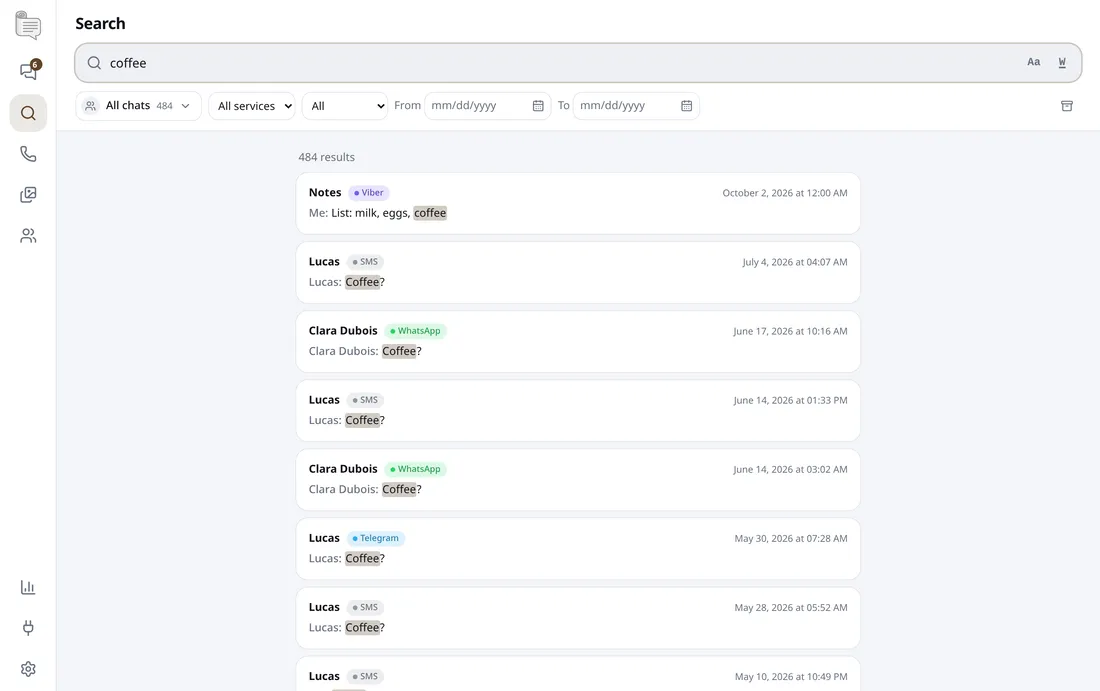
- Chats by person or group, across services, with unread counts, archived, pinned and muted chats, and a filter per service.
- Search across everything, ignoring case and accents, by chat, service, sender and dates.
- People: each one’s numbers and accounts, notes, labels, and suggestions of who may be the same person. Spam from strangers is removed (reported and blocked where the service allows).
- Calls, media and an overview: every call, every picture and file of a chat, and who you talk to most, by service and by year.
- Sending: text, replies, mentions and files; reactions, edits and deletions; forwarding to any chat. Off until you turn it on for each source, with safeguards on WhatsApp.
- Reading is carried to your other devices where the service can do it without telling the sender. Read receipts go out only if you turn them on.
- On the phone it installs from the browser and runs full screen, with notifications of new messages.
- In Ferdium or Franz it has a recipe of its own, with the unread count on its icon.
- Greek and English.
Pictures and the photo library
The archive keeps the record of what each message carried; the pictures themselves can go to your photo library (a folder, or immich) with their real capture date, never the later date of the message. Nothing goes to the library without your approval.
Safe to reach from anywhere
The app is built to be exposed behind HTTPS: passkeys, or a password that is useless without the authenticator’s current code; recovery codes; strict cookies and Content-Security-Policy; limits on sign-in attempts; an audit log of sign-ins and changes. The services’ secrets (sessions, keys) are kept in the system keyring and in an encrypted store, never in the archive or the browser. A private network (WireGuard, Tailscale) works just as well.
Local analysis
People known only by a number or an address can get a suggested name and labels from models that run on your own computer, through Ollama. Nothing is sent out.
Platforms
One program, everysaid, written in Go, for Linux, macOS and Windows on amd64 and arm64. Some
sources depend on their tools: Viber Desktop’s bridge is Linux only, and Signal is built in where
Signal’s library builds (Linux and macOS).